

The Bollards of Financial District’s Streetscape and Security
The Bollards of Financial District’s Streetscape and Security
Twenty-five years ago, September 11th changed how American cities think about security in public space.
Immediately security became a more prominent part of everyday city life: checkpoints, surveillance, barriers, and more sprung up across the country. Public spaces hardened in response to the threat. But as the recent New York Times piece "Consider the Bollard, Stubborn Sidewalk Cop of the Post-9/11 City," by Anna Kodé, points out, even security features get reclaimed by the daily life of the city.

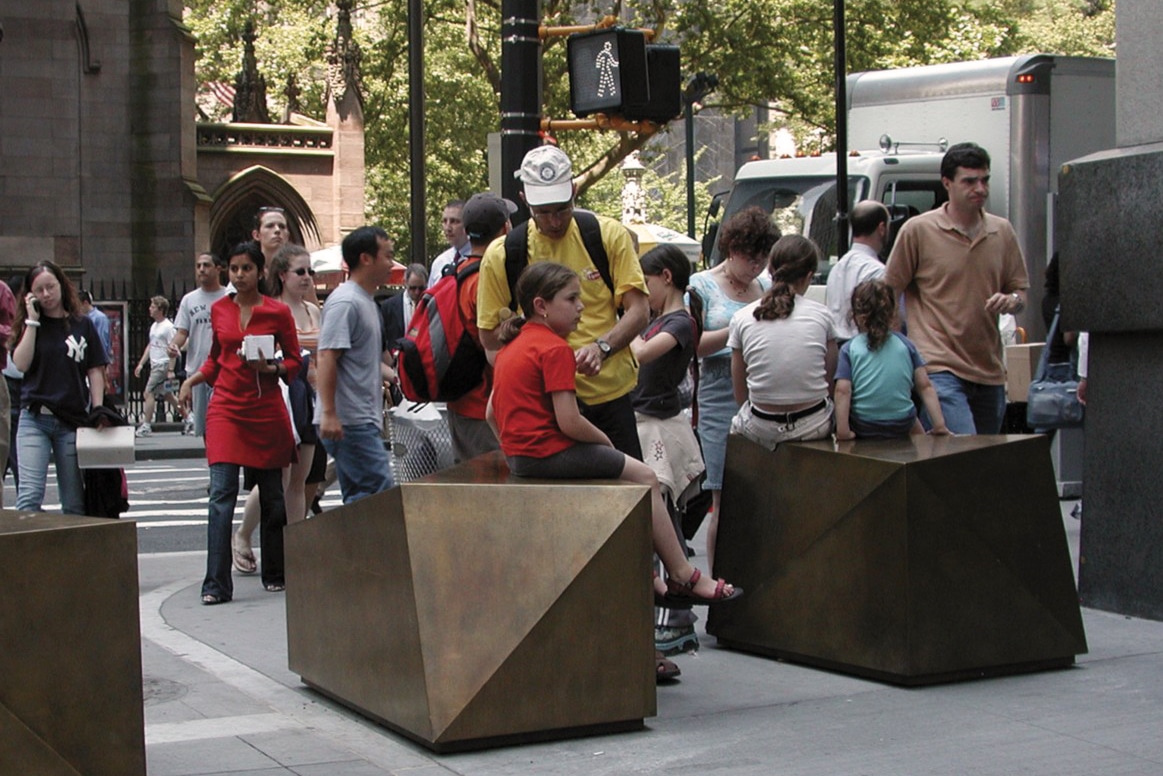
We designed the Financial District's streetscape and security with this instinct from the start. Security improvements must also be pedestrian friendly and make good public space. Working alongside the many city and state agencies who share responsibility for Lower Manhattan's public realm, we reconfigured traffic patterns and introduced pedestrian plazas near key routes and iconic buildings around Wall Street and the New York Stock exchange. We developed deployable faceted bronze barriers we called "NOGOs", to both resist vehicular impact and provide public seating which promotes district identity. What made the effort distinct wasn't just the security it added, but the belief behind it: that a degree of openness in public space is essential to a free society, and that design could protect that openness rather than close it off.


This week, as the city marks 25 years and holds its first official Day of Remembrance and Service, we remember the victims, the first responders, and the families whose lives were changed that day. We are grateful for the opportunity to help the many city agencies in the collective effort to preserve our way of life with safe and open urban spaces.
Twenty-five years ago, September 11th changed how American cities think about security in public space.
Immediately security became a more prominent part of everyday city life: checkpoints, surveillance, barriers, and more sprung up across the country. Public spaces hardened in response to the threat. But as the recent New York Times piece "Consider the Bollard, Stubborn Sidewalk Cop of the Post-9/11 City," by Anna Kodé, points out, even security features get reclaimed by the daily life of the city.
We designed the Financial District's streetscape and security with this instinct from the start. Security improvements must also be pedestrian friendly and make good public space. Working alongside the many city and state agencies who share responsibility for Lower Manhattan's public realm, we reconfigured traffic patterns and introduced pedestrian plazas near key routes and iconic buildings around Wall Street and the New York Stock exchange. We developed deployable faceted bronze barriers we called "NOGOs", to both resist vehicular impact and provide public seating which promotes district identity. What made the effort distinct wasn't just the security it added, but the belief behind it: that a degree of openness in public space is essential to a free society, and that design could protect that openness rather than close it off.
This week, as the city marks 25 years and holds its first official Day of Remembrance and Service, we remember the victims, the first responders, and the families whose lives were changed that day. We are grateful for the opportunity to help the many city agencies in the collective effort to preserve our way of life with safe and open urban spaces.